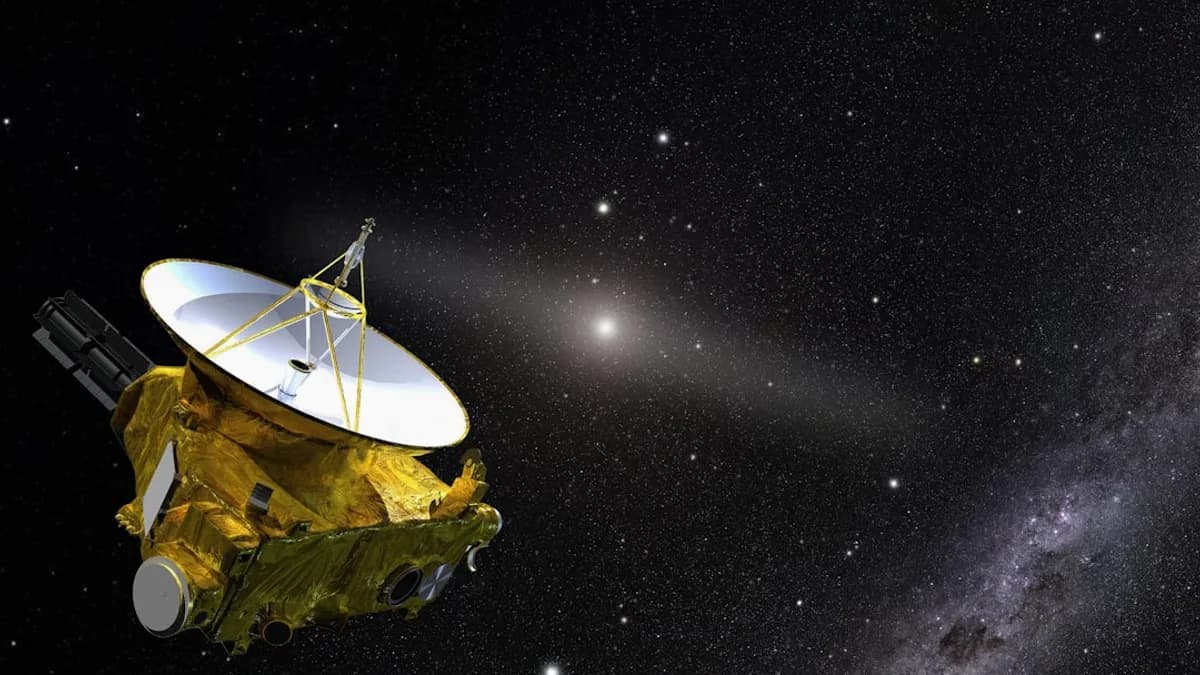
Introduction to Voyager 1 and Its Historic Journey
NASA just turned off a key instrument on Voyager 1 to save power, nearly 15 billion miles from Earth. That’s about 160 times farther than Pluto. Voyager 1 launched in 1977 to study the outer planets, but it kept going. Today, it’s the farthest human-made object in space, floating in a part of the universe no other probe has reached [Source: Google News].
The spacecraft started out studying Jupiter and Saturn. After its main mission, it headed for the edge of the solar system. Voyager 1 crossed into interstellar space in 2012. It now sends back data about cosmic rays, magnetic fields, and particles outside the Sun’s reach. Every day, it sets a new distance record. For scientists, it’s like having a tiny window into the unknown.
Reasons Behind Shutting Off Voyager 1’s Instrument
Voyager 1 is old. It was built with 1970s technology. Its power comes from radioisotope thermoelectric generators (RTGs). These generators use decaying plutonium to make electricity. But the power drops each year as the plutonium fades. After more than 46 years, Voyager 1 has less energy to run its instruments and systems [Source: Google News].
NASA had to make a tough choice. The team shut down the cosmic ray instrument, which tracked high-energy particles from space. This tool helped scientists learn about the boundary between our solar system and interstellar space. But keeping it on would risk running out of power for more critical systems, like communication and navigation. By turning off this instrument, NASA hopes to keep Voyager 1 alive and sending data from other sensors for a few more years. The move is all about squeezing as much science as possible from a fading probe.
Impact of Instrument Shutdown on Voyager 1’s Scientific Mission
Turning off an instrument means losing some valuable data. The cosmic ray detector has played a big role in understanding how the Sun’s influence changes as you move farther out. It has helped track how particles move across the edge of the solar system. Without it, scientists will have fewer ways to study the space between stars [Source: Google News].
NASA has to pick which instruments matter most. With less power, they choose tools that still offer fresh discoveries. Some sensors measure magnetic fields, others track plasma waves. Each one uses precious power, so the team balances science needs with survival. Losing the cosmic ray instrument will slow some research, but Voyager 1 will keep gathering information about interstellar space with its remaining tools. This is a reminder: out here, every watt counts.
Technological Challenges of Operating Spacecraft in Deep Space
Running Voyager 1 in deep space is a huge challenge. Temperatures are freezing. Space radiation can damage electronics. Parts wear out, and repairs aren’t possible. Plus, the RTGs that power Voyager 1 get weaker every year. What started as 470 watts is now less than 200 watts—about enough to run a couple of light bulbs.
Communication is another headache. Signals from Earth take more than 22 hours to reach Voyager 1, and another 22 hours to get back. That means fixing problems takes days. Engineers must plan ahead, sending careful instructions. Even a simple command becomes a test of patience. Compared to newer spacecraft, Voyager 1 works with ancient hardware and software, but it still manages to send back data. The probe’s survival is a masterclass in smart engineering and careful planning.
Broader Implications for Future Deep Space Missions
Voyager 1’s power struggles teach us important lessons for future missions. Engineers now see how crucial it is to manage energy and prioritize tasks. New probes, like the proposed Interstellar Probe, are being designed with power-saving features. They use newer technology, better batteries, and smarter software to last longer.
Teams also learn to make tough choices about what data to collect and what to drop. Sometimes, the goal isn’t to do everything, but to do the most important things well. Balancing scientific ambition with realism keeps missions alive. Voyager 1 shows that even old probes can deliver big results if managed wisely. As we plan missions further into space, these lessons help shape designs, budgets, and goals. A probe’s power isn’t just about electricity—it’s about making every bit of energy count.
Conclusion: Voyager 1’s Legacy and Continuing Exploration
Voyager 1 has changed how we see space. Even as it shuts down instruments, it keeps exploring, sending back clues about what lies beyond our solar system. The probe has survived longer—and gone farther—than anyone expected. Its journey proves that human curiosity can reach across billions of miles.
Voyager 1 inspires new missions and reminds us that smart planning and tough choices can stretch science far beyond its limits. As we build future interstellar probes, we carry the lessons learned from this tiny traveler. The probe’s legacy isn’t just in the data it sends, but in the drive to explore, discover, and keep pushing forward. The next chapter in space exploration will build on what Voyager 1 started, showing that sometimes, the oldest tools can teach us the most [Source: Google News].
Why It Matters
- Voyager 1's shutdown of a key instrument highlights the challenges of operating aging spacecraft far beyond their intended lifespans.
- This decision means scientists will lose some valuable data on cosmic rays and interstellar space at a time when Voyager 1 is our only probe in such a distant region.
- Efforts to conserve power on Voyager 1 reflect the balance between extending mission life and prioritizing critical systems for continued scientific discovery.