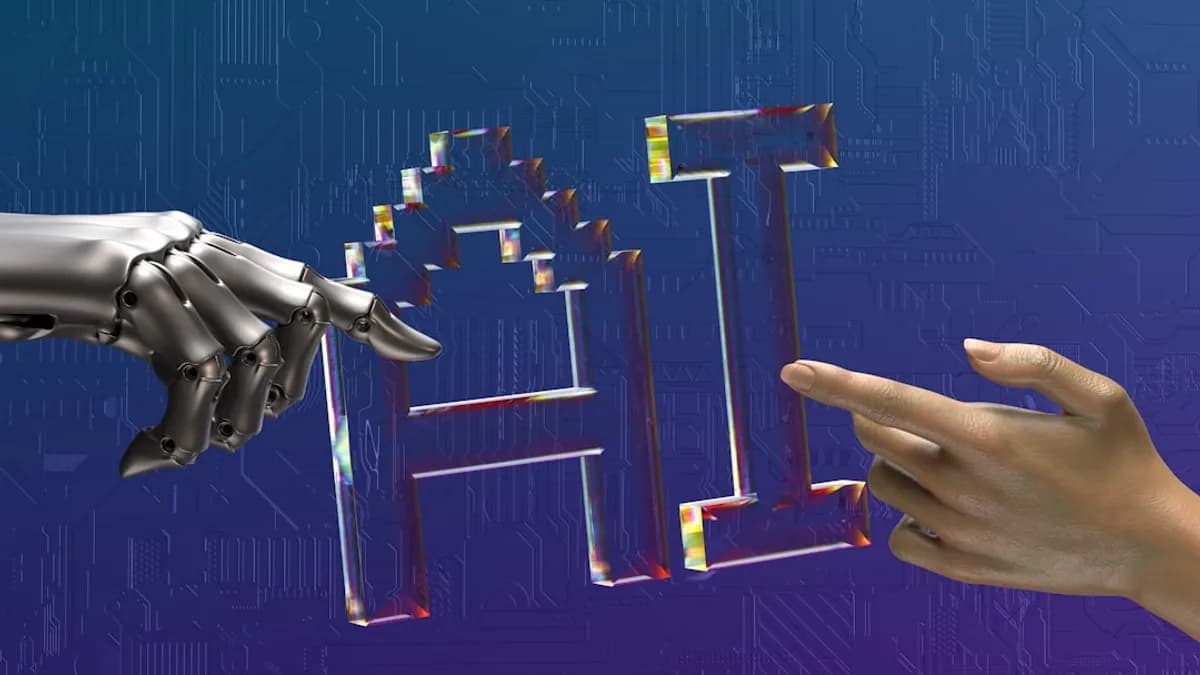
Why Real-Time Multimodal AI Interaction Challenges Traditional Models
Most AI assistants still operate on a rigid turn-based script: you talk, they listen, they stop listening, they respond. This freezes perception and awareness at the very moment when nuance matters most. If you pause mid-sentence, gesture to your camera, or change your mind, the model is oblivious. It’s boxed in by the structure of the conversation, not your intent. That bottleneck—where the model can’t see, hear, or adapt until its turn comes again—limits not just the speed, but the depth of human-AI collaboration.
Thinking Machines Lab, led by Mira Murati, argues that this architecture is fundamentally broken. Their research points to a structural flaw: trying to bolt interactivity onto AI as an afterthought produces clumsy workarounds. Voice-activity detection harnesses, for instance, constantly guess when you’ve finished speaking so the model can finally take its turn. These harnesses are less capable than the models themselves, and they block richer, more natural exchanges—like responding to a raised eyebrow or a simultaneous verbal and visual cue. The result: AI feels less like a thinking partner, more like a slow, single-threaded machine.
This narrow channel throttles the flow of intent and feedback. When AI can’t perceive while it generates, it misses opportunities to clarify, collaborate, or react in context. The vision from Thinking Machines Lab is blunt: if we want AI that evolves alongside us, interactivity must be core to the model, not stitched on top. The need is clear—AI that actually listens, sees, and speaks in real time, as humans do. MarkTechPost lays out how their new research preview aims to break this deadlock.
Dissecting TML-Interaction-Small: Architecture and Technical Innovations
TML-Interaction-Small is not just a bigger model—it’s a rethink of the entire AI communication stack. At its core is a 276-billion parameter Mixture-of-Experts (MoE) architecture, but only 12 billion parameters are active at any moment, making it nimble during inference without sacrificing intelligence.
The headline innovation is the multi-stream, time-aligned micro-turn design. Instead of waiting for a turn to finish, the model slices reality into 200 millisecond chunks. It processes audio, video, and text as a synchronized stream, fusing them at the lowest architectural level. This eliminates the lag and blindness of turn-based models, and—critically—removes the need for external voice-activity detection. The model doesn't wait for a harness to say “now you can listen.” It’s always on.
Two architectural components run in concert. The real-time interaction model maintains a continuous, full-duplex channel with the user, absorbing and generating output without pause. For tasks that demand deeper or longer reasoning—think tool use, web search, or complex planning—the asynchronous background model kicks in. It receives the entire conversational context, does its work off to the side, and streams results back in real time. The interaction model then weaves these responses into the ongoing conversation, precisely when they’re contextually relevant.
Under the hood, the technical departures are striking. There’s no reliance on large, pretrained encoders. Instead, audio is ingested as dMel spectrograms and sent through a lightweight embedding layer, while video frames are parsed into 40x40 patches and processed by a hierarchical MLP. Audio output uses a flow head decoder. All streams are co-trained from scratch, making the model’s multimodal awareness native, not patched on later.
On the backend, inference is optimized for these micro-turns. Instead of re-initializing for each chunk, a persistent in-memory sequence accumulates the 200ms slices, minimizing GPU overhead. This low-latency streaming was upstreamed to SGLang, their open-source inference engine.
Quantifying the Leap: Data and Performance Metrics Behind TML-Interaction-Small
The raw numbers tell part of the story. At 276B parameters, TML-Interaction-Small approaches the size of leading foundation models, yet cleverly activates only 12B at inference—a balance between power and efficiency. This is on par with or larger than most production multimodal models, though the unique MoE structure keeps compute in check.
Latency is where the design shows its teeth. By dividing interactions into 200ms micro-turns, the system can respond, interpret, and update context almost as quickly as a human conversation. This micro-chunking means the model doesn’t freeze out new information while generating output—a key failing of previous architectures. Early research previews claim “state-of-the-art combined performance in intelligence and responsiveness,” though explicit benchmark numbers are not disclosed in the source.
Contextual understanding improves as well. Since both the real-time and background models operate over a shared, full conversation context, the system avoids the abrupt context switches that plague current assistants. Updates and tool outputs are woven back in naturally, not dumped in as afterthoughts. The result, as described in the research, is AI that can handle true simultaneous speech, react to nonverbal cues mid-interaction, and deliver results without halting the flow.
The model’s effectiveness is still being validated, but the qualitative leap in real-time multimodal interaction is the core claim. If those early results hold, the bar for responsiveness and collaboration in AI will move sharply upward.
Diverse Stakeholder Perspectives on Native Multimodal AI Interaction Models
Researchers see the architectural shift as a direct challenge to the “bitter lesson” in AI—that hand-crafted, specialist harnesses get outpaced by scaling general-purpose intelligence. Native interactivity, they argue, allows scaling to directly increase both IQ and social fluency. From a research standpoint, this opens the door to exploring not just what AI knows, but how it collaborates.
Industry experts, especially those building tools for real-time collaboration, are watching the implications for product design. A model that natively processes and responds to simultaneous streams could make current “AI assistants” obsolete, replacing them with partners that feel present and adaptive. For sectors like customer service or education, this could mean agents and tutors that see and respond to users as people, not just text strings.
Privacy advocates, on the other hand, will zero in on the risks of continuous, always-on multimodal data processing. A model that’s constantly listening, watching, and inferring intent raises stakes for surveillance and consent—especially if deployed beyond the lab. While the research preview focuses on technical achievement, the societal implications will demand scrutiny.
User experience designers glimpse a future where interaction fluidity is no longer a constraint. The micro-turn architecture allows for interruptions, corrections, and layered communication—hallmarks of natural human conversation. Usability could improve dramatically, but only if users trust the model to respect context and intent, not just data.
Tracing the Evolution: How TML-Interaction-Small Builds on Past AI Interaction Paradigms
Turn-based models have dominated since the rise of chatbots and smart assistants. These systems were built for a world where typing or speaking was the only channel—and only one party spoke at a time. Attempts to push beyond this, such as layering voice-activity detection or bolting on visual modules, often resulted in brittle, laggy systems that stumbled when users acted unpredictably.
Multimodal models did appear, notably with architectures that glued together pretrained encoders for speech and vision. But these were fundamentally asynchronous: they processed one modality, then switched to another, never achieving true simultaneity. The Mixture-of-Experts approach, scaled up in TML-Interaction-Small, brings two advantages. First, it allows the model to dynamically route compute where it’s needed, keeping inference practical at massive scales. Second, it enables the fusion of modalities at a low level, not just at the output.
The shift from asynchronous to synchronous, continuous interaction is the real milestone. Instead of treating multimodality as a post-hoc feature, TML-Interaction-Small bakes it into the DNA of the model. The result: a system that acts more like a collaborative partner than a call-and-response automaton.
Implications of Real-Time Multimodal AI for Industry and Everyday Users
If this research preview matures, the impact could be profound. Customer service could move from wait-your-turn chatbots to agents that see, hear, and respond in the moment—picking up on confusion, frustration, or nonverbal cues. In healthcare, real-time multimodal understanding could support telemedicine with conversational and visual context, rather than relying solely on patient descriptions.
Education stands to gain as well. Tutors that can see both a student’s work and their reactions could adapt instruction instantly, rather than cycling through slow, turn-based exchanges. Productivity tools could shift from button-driven interfaces to collaborative, conversation-driven workflows, where the line between intent and action blurs.
But challenges loom. The computational cost of maintaining persistent, multimodal real-time streams is nontrivial. Infrastructure must evolve to support low-latency, high-bandwidth AI interaction—especially if models scale further. Trust and accessibility will also be in focus. Users must believe that always-on systems handle their data securely, and that the interaction remains natural, not uncanny.
Adoption will hinge not just on technical capability, but on whether these systems can earn their place in workflows and daily life.
Forecasting the Future: What TML-Interaction-Small Means for Next-Gen AI Development
If TML-Interaction-Small’s architecture proves scalable, the next wave of AI models will likely move toward native, real-time multimodal interaction. This could dovetail with advances in AR/VR and IoT, where context-aware, always-present assistants become not just possible but indispensable. Imagine AI that seamlessly mediates between what you say, what you see, and what you intend—without the friction of context switches or mode changes.
Research previews like this one serve as accelerators. By demonstrating what’s possible, they set a new bar for both intelligence and collaboration, forcing the industry to rethink assumptions about how AI should interact. The long-term vision: context-aware, fully collaborative agents that fit into human workflows as naturally as another person.
What remains to be seen is how these models will handle the tradeoff between responsiveness and privacy, and whether the computational demands can be met at scale. Will users embrace systems that are always listening and watching, if they feel truly understood and empowered? Or will concerns over data and control slow adoption?
The evidence to watch: real-world benchmarks for latency and accuracy, pilot deployments in high-stakes domains, and user trust metrics as continuous multimodal AI moves from lab to life. If TML-Interaction-Small’s core claims hold, the way we work with AI will shift from turn-taking to true collaboration. That’s a leap worth tracking.
Why It Matters
- Traditional AI assistants miss out on natural, nuanced human signals due to rigid, turn-based designs.
- TML's native multimodal approach could enable AI to collaborate in real time, making interactions more intuitive and efficient.
- This architectural shift is necessary for AI to evolve from passive responders to true thinking partners.